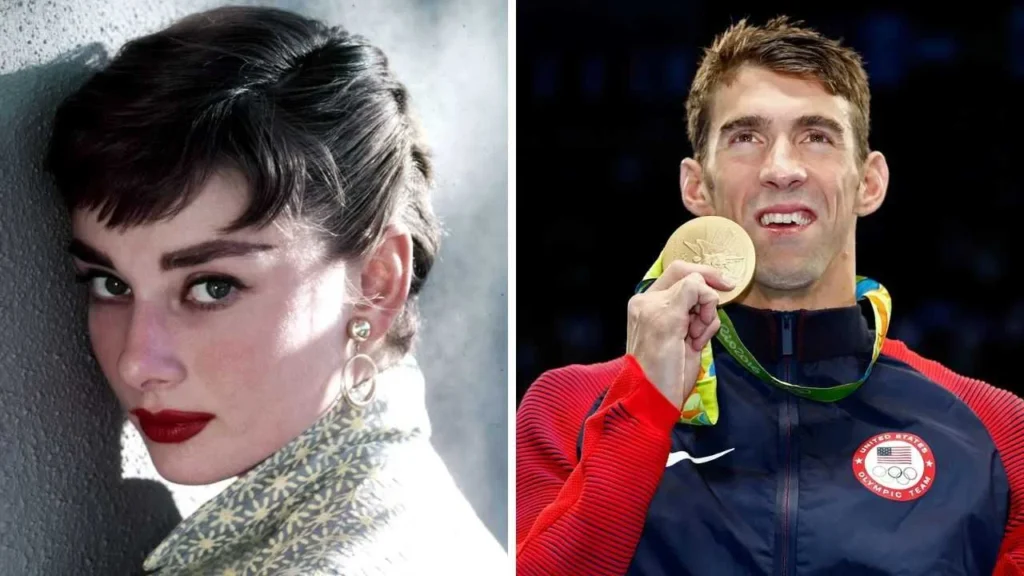

Audrey Hepburn and Michael Phelps are two internationally recognized names whose achievements have left a lasting mark on entertainment and sports. Although they belong to different generations and professional worlds, both represent dedication, talent, perseverance, and the power of a lasting legacy.
Audrey Hepburn became one of Hollywood’s most beloved actresses, admired for her elegance, memorable performances, and humanitarian work. Michael Phelps, meanwhile, transformed competitive swimming through his extraordinary Olympic achievements and became one of the most decorated athletes in modern sports history.
Exploring Audrey Hepburn and Michael Phelps together offers an interesting look at how two individuals from very different backgrounds reached extraordinary levels of success. Their stories reveal how discipline, personal growth, and commitment to a craft can shape a person’s influence far beyond their original profession.
Audrey Hepburn: Early Life, Background, and Rise to Fame
Audrey Kathleen Hepburn was born on May 4, 1929, in Brussels, Belgium. She spent parts of her childhood in England and the Netherlands, and her early years were shaped by the uncertainty and hardship of World War II. Before becoming an internationally recognized actress, Hepburn studied ballet and developed an interest in performing arts. Her experiences during the war later influenced her understanding of hunger, poverty, and the importance of helping vulnerable children.
Hepburn’s journey into acting began with small film appearances and stage opportunities. Her breakthrough came through the Broadway production of Gigi, which helped introduce her to American audiences. In 1953, she starred opposite Gregory Peck in Roman Holiday, playing Princess Ann, a royal who experiences an unexpected adventure in Rome. The performance earned Hepburn the Academy Award for Best Actress and established her as a major Hollywood star. Her natural screen presence, expressive acting, and distinctive style helped her stand apart in an industry filled with established performers.
Audrey Hepburn’s Career, Achievements, and Hollywood Legacy
Audrey Hepburn built a remarkable film career through roles that balanced charm, emotional depth, and sophistication. After Roman Holiday, she appeared in celebrated productions such as Sabrina, Funny Face, Breakfast at Tiffany’s, Charade, My Fair Lady, and Wait Until Dark. Her portrayal of Holly Golightly in Breakfast at Tiffany’s became one of the defining performances of her career, while her dramatic work demonstrated that her abilities extended well beyond romantic comedy. Hepburn earned multiple Academy Award nominations, winning for Roman Holiday. Her performances remain part of classic cinema, attracting new audiences decades after their original release.
Hepburn’s influence also extended into fashion and popular culture. Her collaborations with designer Hubert de Givenchy helped establish a visual style associated with clean lines, understated elegance, and timeless clothing. Yet her legacy cannot be measured by film roles or fashion alone. Later in life, she devoted considerable energy to humanitarian work, becoming a UNICEF Goodwill Ambassador in 1988. She visited communities facing poverty, hunger, and limited access to healthcare, using her public profile to raise awareness. Her career therefore offers an example of how a public figure’s influence can evolve from professional success into service to others.
Michael Phelps: Early Life and the Beginning of a Swimming Career
Michael Fred Phelps II was born on June 30, 1985, in Baltimore, Maryland, United States. He grew up in a supportive family and began swimming at a young age. The sport soon became an important part of his daily routine, and his natural ability, combined with structured training, helped him progress rapidly. Under the guidance of coach Bob Bowman, Phelps developed the technical skills, endurance, and competitive discipline that would later define his career. His early development illustrates how athletic potential can be strengthened through consistent practice, expert coaching, and long-term commitment.
Phelps reached the international stage at just 15 years old when he competed at the 2000 Sydney Olympic Games. Although he did not win a medal in Sydney, his participation marked the beginning of an extraordinary Olympic journey. In 2001, he set a world record in the 200-meter butterfly, becoming the youngest male swimmer to achieve that milestone at the time. These early accomplishments signaled his potential across multiple swimming events. Rather than achieving worldwide fame overnight, Phelps built his reputation through years of training, competition, and progressively stronger performances.
Michael Phelps’ Olympic Achievements and Lasting Legacy
Michael Phelps became a defining figure in Olympic swimming through his performances at four Olympic Games between 2004 and 2016. At the Athens 2004 Olympics, he won six gold medals and two bronze medals. His achievements reached another level at the Beijing 2008 Olympics, where he won eight gold medals in a single Games, setting a record for the most gold medals won by an athlete at one Olympic edition. His performances in Beijing drew worldwide attention and strengthened his reputation as one of the most accomplished competitors in Olympic history.
Michael Phelps’ Olympic medal record
23
Gold medals
3
Silver medals
2
Bronze medals
28 total Olympic medals
Across Sydney 2000, Athens 2004, Beijing 2008, London 2012, and Rio 2016. Source: World Aquatics.
Phelps continued competing at the highest level through the London 2012 and Rio 2016 Olympics. He retired from competitive swimming after Rio, leaving behind a record of 28 Olympic medals, including 23 gold. His success helped bring greater attention to competitive swimming and inspired athletes to pursue ambitious goals. Phelps also established the Michael Phelps Foundation, which focuses on water safety, swimming, and healthy living. His legacy includes both his competitive achievements and his efforts to encourage participation in swimming and support well-being beyond elite sport.
Audrey Hepburn and Michael Phelps: Similarities and Differences
Audrey Hepburn and Michael Phelps worked in very different environments, but their careers share several meaningful themes. Both reached the highest levels of achievement in their respective fields, earned international recognition, and became familiar names far beyond their professional communities. Hepburn’s success came through acting, screen presence, and her ability to portray a wide range of characters. Phelps built his reputation through athletic performance, technical precision, and years of competitive preparation. Their stories demonstrate that global recognition can emerge through different forms of talent and dedication.
Their paths also differed in important ways. Hepburn’s career developed within the collaborative world of cinema, where directors, writers, designers, and fellow performers contributed to the final work. Phelps competed in a measurable sporting environment, where times, placements, and medals documented performance. Hepburn’s influence grew across film, fashion, and humanitarian advocacy, while Phelps became known primarily for swimming and Olympic achievement before expanding into charitable initiatives. Neither story needs to be measured against the other: each reflects a distinct kind of accomplishment and a different route to public influence.
Public Influence, Humanitarian Work, and Personal Legacy
One of the most significant aspects of Audrey Hepburn’s legacy is her humanitarian commitment. Her work with UNICEF was closely connected to her childhood experiences of wartime hunger and hardship. As a Goodwill Ambassador from 1988 to 1993, she visited countries affected by poverty, famine, and humanitarian emergencies. She advocated for children’s rights and helped bring international attention to the needs of vulnerable communities. In 1992, she received the Presidential Medal of Freedom in recognition of her humanitarian contributions. Her work showed how an established public figure could use recognition to support a cause beyond personal achievement.
Michael Phelps also developed a public role beyond competition. After retiring from swimming, he became involved in initiatives supporting water safety, physical activity, and mental well-being. He has spoken publicly about mental health challenges, helping bring attention to an issue that athletes may find difficult to discuss. Through the Michael Phelps Foundation and other public efforts, he has continued contributing to the swimming community. While Hepburn and Phelps pursued different causes and worked in different eras, both demonstrate that a public legacy can continue to develop after a person’s most celebrated professional achievements have ended.
What Audrey Hepburn and Michael Phelps Teach Us About Success
The lives of Audrey Hepburn and Michael Phelps offer several useful lessons for readers interested in personal growth, career development, or achievement. One lesson is the value of consistent effort. Hepburn developed her performance skills through ballet, stage work, and film experience, while Phelps spent years refining his swimming technique and preparing for international competition. Their success was not simply the result of being recognized or naturally talented. Both invested time in developing their abilities and continued working toward demanding goals.
Another lesson is that achievement can take different forms. Hepburn’s influence extended from acting into humanitarian advocacy, while Phelps moved from Olympic competition into charitable and public initiatives. Their careers remind readers that professional success does not have to be the final destination. Skills, experience, and public visibility can be used in new ways over time. For anyone pursuing a personal ambition, their stories offer a reason to focus on steady improvement, meaningful goals, and the kind of contribution they hope to make beyond their immediate accomplishments.
Frequently Asked Questions About Audrey Hepburn and Michael Phelps
Were Audrey Hepburn and Michael Phelps connected personally?
There is no widely documented personal or professional connection between Audrey Hepburn and Michael Phelps. They are discussed together because of their global recognition and achievements in different fields.
What was Audrey Hepburn famous for?
Audrey Hepburn was a celebrated actress known for films such as Roman Holiday, Breakfast at Tiffany’s, and My Fair Lady. She was also recognized for her humanitarian work with UNICEF.
How many Olympic medals did Michael Phelps win?
Michael Phelps won 28 Olympic medals: 23 gold, three silver, and two bronze. He earned these medals across five Olympic Games, from Sydney 2000 to Rio 2016.
What similarities do Audrey Hepburn and Michael Phelps share?
Both achieved international recognition through exceptional dedication to their professions. They also developed public legacies beyond their primary careers, with Hepburn supporting children’s rights and Phelps promoting swimming and well-being.
Why are Audrey Hepburn and Michael Phelps still remembered today?
Hepburn remains influential through her films, fashion legacy, and humanitarian work. Phelps is remembered for his Olympic records, swimming achievements, and contributions to the sport after retirement. Their accomplishments continue to interest audiences across generations.
Conclusion
Audrey Hepburn and Michael Phelps represent two remarkable journeys shaped by dedication, talent, and lasting influence. Hepburn captivated audiences through her unforgettable performances and humanitarian commitment, while Phelps redefined Olympic swimming with his historic medal record. Although their careers unfolded in different fields and generations, both demonstrated how sustained effort can create a legacy that reaches beyond professional success. Their stories continue to inspire people interested in entertainment, sports, and personal growth. Explore more biographies of influential personalities to discover how their experiences, achievements, and contributions have shaped the world.