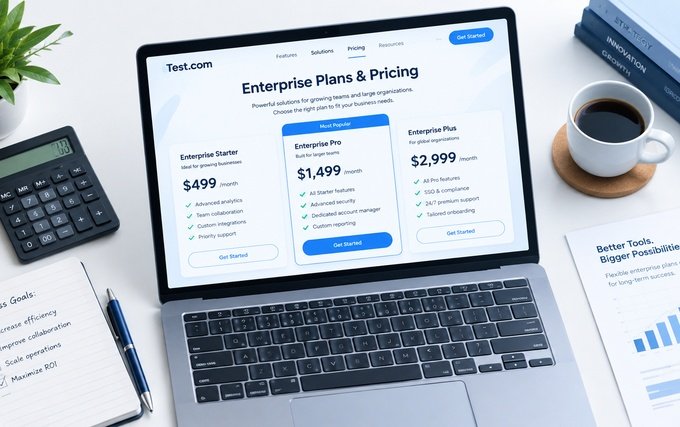

Navigating the landscape of enterprise assessment platforms requires a clear understanding of costs, features, and scalability options. Test.com has established itself as a significant player in the online testing and certification management space, offering solutions designed for government agencies, trade organizations, training providers, and large enterprises. For organizations managing thousands of candidates annually, understanding the nuances of Test.com pricing enterprise plans becomes essential for accurate budgeting and strategic decision-making.
Understanding Test.com Pricing Enterprise Plans Structure
Test.com employs a tiered pricing model that separates smaller organizational needs from large-scale enterprise requirements. The published Professional plan starts at $750 annually, with additional hosting fees of $250 and a one-time setup fee of $500. However, this tier includes eight usage-based pricing levels, meaning costs escalate as testing volume increases. Organizations exceeding 10,000 tests per year typically transition into the enterprise pricing model, where volume-based custom quotes replace fixed pricing.
The enterprise tier operates on a negotiated basis, with pricing tailored to the specific scale and complexity of each organization’s testing program. This approach acknowledges that a credentialing body running high-stakes certification exams with proctoring, payments, and external integrations has fundamentally different requirements than a company conducting simple internal quizzes. The enterprise model incorporates volume discounts and custom terms that reflect the organization’s commitment level and projected usage patterns.
Key Cost Factors That Influence Enterprise Pricing
Several variables determine the final cost of Test.com enterprise plans. Test volume serves as the primary driver, with organizations delivering more than 10,000 assessments annually moving into the enterprise bracket where volume pricing is built around program size. The percentage of exams requiring live or recorded proctoring significantly impacts costs, as proctoring can be purchased in bundles, per exam, or passed through to test takers. This flexibility allows organizations to align proctoring expenses with their specific security requirements and candidate payment models.
Integration complexity represents another critical cost factor. While Test.com supports REST API, webhooks, and SSO capabilities in its enterprise offering, the scope of integration work varies considerably. Simple connections may be handled by internal development teams, while complex LMS, CRM, or custom system integrations may require vendor assistance, data mapping, and extensive testing. Procurement teams should clarify exactly what integration work is included in the enterprise price versus what constitutes billable professional services.
Feature Comparison Across Test.com Enterprise Tiers
When evaluating Test.com pricing enterprise plans, understanding the feature distinctions between Professional and Enterprise tiers prevents costly misjudgments. The Professional plan provides essential testing functionality with usage-based pricing levels, making it suitable for smaller credentialing bodies that fit within its volume parameters. Enterprise plans unlock capabilities that larger organizations require, including unlimited question storage, unlimited custom tests, and unlimited teammate accounts for collaborative content development.
Enterprise-tier features extend to learner accounts with persistent candidate profiles for long-term tracking, SSO integrations with enterprise identity providers, and automatic recording retention policies. Service level agreements guarantee uptime and response times, while named account managers provide dedicated support. Custom API development addresses specific technical requirements, and webhooks enable real-time assessment event delivery to external systems. These features collectively support complex certification workflows that smaller plans cannot accommodate.
The Role of Proctoring in Enterprise Cost Calculations
Proctoring requirements can dramatically alter the total cost of ownership for Test.com enterprise plans. The platform supports multiple proctoring models, allowing organizations to purchase proctoring in bundles, buy it on a per-exam basis, or pass the cost directly to test takers. This flexibility creates several possible cost structures, and the optimal approach depends on your organization’s certification model and candidate expectations. A professional certification body may absorb proctoring costs as part of its value proposition, while other organizations may prefer candidates to bear this expense.
The percentage of exams requiring proctoring directly influences budgeting accuracy. If only a fraction of assessments need live supervision, a bundle purchase may suffice. Conversely, organizations where every exam requires proctoring should negotiate enterprise-wide proctoring rates that reflect their full volume. The critical takeaway is that proctoring should appear as a separate line item in any enterprise quote, distinct from the platform subscription cost. This transparency enables accurate comparison between vendors and prevents unexpected cost overruns.
Integration, API, and Migration Considerations
Enterprise buyers rarely evaluate testing platforms in isolation. The ability to connect with existing learning management systems, customer relationship management tools, and internal databases often determines whether a platform can realistically serve organizational needs. Test.com enterprise plans support REST API, webhooks, and SSO, with documented integrations for LMS, CRM, and custom internal systems. However, “integration available” differs fundamentally from “integration included.” Procurement discussions should clarify which integration components—API access, SSO configuration, webhook setup, or LMS connectivity—are covered by the enterprise price and which require additional professional services fees.
Migration represents another cost dimension that organizations frequently underestimate. Transitioning from a legacy platform involves importing user records, test histories, question banks, and certification data. Test.com supports bulk data migration through CSV, and the enterprise tier includes data migration assistance. The practical question becomes what migration work is included in setup versus billed separately. Large exam programs with years of accumulated content and historical data may require extensive data cleaning, format conversion, and validation efforts that exceed standard migration support.
Professional vs. Enterprise: Determining the Right Fit
The distinction between Professional and Enterprise plans extends beyond pricing levels. Professional plans suit organizations with straightforward testing requirements that fit within defined usage tiers, while Enterprise plans serve programs requiring unlimited content, formal service guarantees, and custom legal terms. A smaller credentialing body delivering fewer than 10,000 tests annually may operate effectively on the Professional plan, even after adding necessary features. The upgrade point occurs when the organization’s needs exceed what usage-based tiers can economically accommodate.
Organizations should evaluate their trajectory rather than just current requirements. A certification program experiencing rapid growth may benefit from enterprise terms that accommodate future expansion without repeated renegotiation. The enterprise model also provides access to features that smaller plans may not offer, including SLA-backed performance guarantees, dedicated candidate support channels, and custom API development. These capabilities matter most for programs where downtime or performance issues carry significant reputational or compliance consequences.
Negotiating Test.com Enterprise Contracts
Enterprise contracts involve negotiation beyond published pricing. Test.com offers custom terms for enterprise clients, including unlimited content limits, enterprise authentication, formal service guarantees, and legal terms tailored to organizational requirements. Organizations should approach negotiations with a clear understanding of their projected volume, integration needs, and compliance requirements. Multi-year commitments may unlock additional discounts, but organizations should balance savings against the flexibility to adapt as testing programs evolve.
Payment terms represent a negotiable element in enterprise agreements. Standard terms may require annual prepayment, but organizations with established credit relationships may negotiate quarterly or milestone-based payment schedules. Contract renewal provisions deserve scrutiny, particularly clauses governing price increases at renewal. Understanding notice periods for rate adjustments and the right to terminate without penalty provides leverage during initial negotiations. A well-structured enterprise agreement should protect the organization from unexpected cost escalation while ensuring the vendor can sustainably support the platform.
Calculating Total Cost of Ownership for Enterprise Plans
Total cost of ownership extends far beyond the platform subscription fee. Organizations must account for implementation costs, data migration, integration development, proctoring expenses, payment processing fees, and ongoing administrative overhead. Test.com supports Stripe and PayPal Express Checkout for organizations delivering paid exams or certification programs, but payment providers maintain their own transaction fees. A paid certification business should calculate two distinct numbers: the platform’s charges and the per-transaction cost of processing each payment.
Internal resource requirements also factor into total cost calculations. Platform administration, content development, candidate support, and technical integration work consume staff time that carries opportunity costs. Enterprise features like named account managers and hands-free onboarding reduce internal burden, but organizations should honestly assess what capabilities they can support internally versus what they need the vendor to provide. The most accurate TCO model separates hard costs (subscription, proctoring, payment fees) from soft costs (staff time, training, change management).
Practical Recommendations for Enterprise Buyers
Organizations evaluating Test.com pricing enterprise plans should request detailed quotes that separate platform costs from proctoring, integration, migration, and payment processing fees. This transparency enables accurate comparison between vendors and supports internal budget approval processes. Procurement teams should involve stakeholders from IT, compliance, finance, and program management early in the evaluation to ensure all requirements are captured and weighted appropriately.
Pilot programs or phased implementations reduce risk while validating platform fit. Rather than migrating all assessment programs simultaneously, organizations can launch a single certification track or training program on the new platform and evaluate performance before expanding. This approach surfaces integration issues, candidate experience concerns, and administrative workflow challenges while the scope remains manageable. The insights gained during a pilot inform final contract negotiations and implementation planning for broader organizational adoption.
Conclusion
Test.com pricing enterprise plans reflect the platform’s focus on serving organizations with substantial assessment volumes and complex certification requirements. The transition from Professional to Enterprise occurs not merely at a volume threshold but when an organization’s needs exceed what usage-based tiers can economically and functionally support. Enterprise plans deliver unlimited content, formal service guarantees, SSO authentication, custom API development, and negotiated contract terms designed for large-scale testing operations.
Successful enterprise procurement requires looking beyond headline pricing to understand total cost of ownership. Proctoring, integration, migration, and payment processing represent distinct cost categories that must be evaluated separately. Organizations that approach Test.com enterprise negotiations with clear requirements, accurate volume projections, and a phased implementation strategy position themselves to maximize value from their assessment infrastructure investment. The right enterprise plan delivers not just cost efficiency at scale but the reliability, security, and flexibility that high-stakes certification programs demand.