
The Cadillac LYRIQ has become an important name in the luxury electric SUV market, combining a large battery, refined ride quality, strong acceleration, and multiple driving settings. For EV owners, however, one practical question often matters more than performance figures: do Cadillac LYRIQ driving modes offer different ranges or battery usage? The short answer is that the modes can influence energy consumption indirectly, but Cadillac does not publish a separate EPA range figure for each standard driving mode.
The LYRIQ’s available modes are designed primarily to change the vehicle’s driving characteristics rather than create entirely separate battery configurations. Cadillac lists Tour, Snow/Ice, Sport, and My Mode among the LYRIQ’s driving modes, with each intended for a different driving situation. The vehicle also offers regenerative-braking features that can influence how efficiently energy is recovered during deceleration.
What Are the Cadillac LYRIQ Driving Modes?
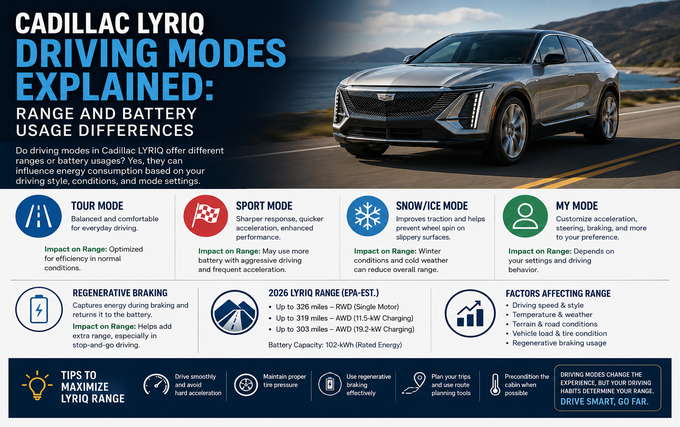
The Cadillac LYRIQ provides several ways to tailor its driving behavior. Tour is the everyday setting, designed around a smooth and comfortable driving experience. Sport is intended to provide a more immediate driving response, including quicker torque response and a stronger feeling of connection with the road. Snow/Ice is designed to help reduce wheel spin when traction is limited, while My Mode lets drivers personalize selected characteristics of the vehicle.
These settings do not function like different battery packs. Instead, they adjust elements of the vehicle’s response, such as accelerator behavior, steering feel, braking response, and other performance characteristics. Cadillac’s general Driver Mode Control guidance explains that the available modes depend on the vehicle and equipment, while the LYRIQ’s specific information identifies Tour, Snow/Ice, Sport, and My Mode. Therefore, changing modes should be viewed primarily as changing the driving experience rather than selecting a separate battery-efficiency program.
Does Changing Driving Mode Change LYRIQ Range?
Changing the driving mode can affect real-world range, but the effect is not necessarily a fixed number of miles. Cadillac’s published range ratings are associated with the vehicle’s configuration rather than with separate EPA ratings for Tour, Sport, Snow/Ice, or My Mode. For the 2026 LYRIQ, Cadillac lists up to 326 miles of EPA-estimated range for single-motor rear-wheel-drive models and up to 319 miles for certain dual-motor all-wheel-drive configurations.
The reason a driving mode can influence range is that it can change how the vehicle responds to the accelerator and how aggressively a driver uses the available performance. Sport mode, for example, is calibrated for more immediate torque response. If that calibration encourages stronger acceleration, the driver may consume energy more quickly. However, the mode itself should not be interpreted as automatically removing a predetermined number of miles from the LYRIQ’s estimated range. Actual range varies with speed, temperature, terrain, traffic, driving style, vehicle load, and other conditions.
How Tour Mode Can Support Efficient Everyday Driving
Tour mode is the natural starting point for drivers who want a balanced LYRIQ experience. Cadillac describes it as the predominant everyday mode, with tuning and calibration intended to deliver a smooth ride. For normal commuting, city driving, and highway travel, this setting can make it easier to maintain a relaxed driving rhythm rather than constantly seeking maximum acceleration.
That does not mean Tour mode guarantees the longest possible range under every circumstance. A driver can still use substantial battery energy in Tour mode by traveling at high speeds, accelerating aggressively, carrying heavy loads, or driving in unfavorable weather. Conversely, a careful driver using another mode may achieve efficient results. The important point is that Tour mode is oriented toward everyday refinement, and its characteristics can make moderate energy consumption easier to achieve in ordinary driving conditions.
Does Sport Mode Use More Battery?
Sport mode has the greatest potential to increase energy consumption through driving behavior. Cadillac says Sport mode provides a more immediate torque response and is calibrated to enhance the feeling of road connection. In an electric vehicle, strong acceleration requires substantial power from the battery, particularly when the driver repeatedly uses the vehicle’s available performance.
However, Sport mode does not mean that the LYRIQ continuously consumes the same higher amount of energy simply because the mode is selected. Energy consumption depends heavily on what the driver actually does. Using Sport mode while cruising gently may have a much smaller effect than repeatedly accelerating hard. Therefore, the most accurate answer to “do the driving modes in Cadillac Lyriq offer different ranges or battery usages?” is that Sport can contribute to higher consumption when its performance characteristics are actively used, but Cadillac does not specify a universal Sport-mode range penalty.
What Does Snow/Ice Mode Do to Battery Consumption?
Snow/Ice mode is designed for situations where traction is limited. Its purpose is not to maximize driving range but to help the vehicle behave more predictably on slippery surfaces. Cadillac identifies Snow/Ice as a mode intended to help prevent wheel spin in snow and other slippery driving conditions.
In real-world winter driving, range can be affected by factors beyond the selected mode. Cold temperatures can reduce EV efficiency, while snow-covered roads, lower tire traction, cabin heating, and other environmental conditions can increase energy consumption. As a result, a LYRIQ driven in Snow/Ice mode during winter may show lower real-world range than the same vehicle driven on dry roads in mild temperatures. That difference should not automatically be attributed to the mode itself.
How My Mode Can Influence LYRIQ Efficiency
My Mode is particularly interesting because it allows the driver to personalize aspects of the LYRIQ’s behavior. Cadillac says My Mode can be used to change characteristics including accelerator responsiveness, steering feel, braking responsiveness, and Electric Vehicle Sound Enhancement.
Because the driver can customize the vehicle, My Mode does not have one universal efficiency profile. A conservative setup with a smoother accelerator response may encourage gentle inputs, while a more performance-oriented configuration can make the vehicle feel more responsive. The actual energy result still depends on driving conditions and behavior. My Mode is therefore better understood as a customization feature than as a dedicated “maximum range” setting.
How Regenerative Braking Affects Battery Usage
Regenerative braking is an important part of understanding LYRIQ energy consumption because it allows some of the vehicle’s kinetic energy to be recovered during deceleration. Cadillac specifically describes regenerative braking as a way to conserve and capture braking energy for added range. The LYRIQ also offers One-Pedal Driving settings and a steering-wheel-mounted Regen on Demand paddle.
Regeneration does not create free energy or eliminate all losses. Instead, energy that would otherwise be dissipated during braking can be converted back into electrical energy and returned to the battery. How much energy is recovered depends on the road, speed, traffic, driving style, and braking behavior. In stop-and-go conditions, effective regenerative braking can be particularly useful, while steady highway driving offers fewer opportunities for significant energy recovery.
Which LYRIQ Configuration Has the Best Range?
Driving mode is only one part of the range equation. The LYRIQ’s powertrain configuration can have a much more direct effect on its official range rating. Cadillac’s 2026 specifications list up to 326 miles of EPA-estimated range for the single-motor RWD LYRIQ. Certain dual-motor AWD versions are listed at up to 319 miles with standard 11.5-kW charging and 303 miles with available 19.2-kW charging, according to Cadillac’s specifications page.
These figures demonstrate why buyers should distinguish between charging capability, battery capacity, powertrain configuration, and driving mode. Cadillac lists a 102-kWh rated energy capacity for the LYRIQ battery platform, while the vehicle’s range varies by configuration. Charging power affects how quickly energy can be added, whereas driving conditions determine how quickly that stored energy is consumed.
What Factors Affect LYRIQ Range More Than Driving Mode?
For most owners, driving speed and environmental conditions can have a greater practical influence on range than simply switching between standard driving modes. Highway speeds can increase aerodynamic energy demand, while cold weather can affect EV efficiency and increase heating requirements. Hills, strong winds, traffic, tire condition, vehicle load, and repeated acceleration can also change consumption.
This is why two LYRIQ drivers using the same mode can receive noticeably different range estimates. Cadillac itself notes that actual EV range can vary based on factors such as temperature, terrain, battery age, loading, use, and maintenance. The company’s route-planning tools can also estimate battery level at arrival and help drivers locate charging stations, giving owners a more practical way to manage longer journeys.
How to Maximize Cadillac LYRIQ Range
Drivers looking to maximize LYRIQ range should concentrate on smooth acceleration, sensible highway speeds, proper tire maintenance, and effective use of regenerative braking. Using the vehicle’s available route-planning tools can also help anticipate charging stops and reduce unnecessary detours. Cadillac’s myCadillac ecosystem includes route-planning and range features designed to help drivers understand current battery status and plan charging.
It is also useful to think about driving mode as a supporting tool rather than the main source of efficiency. Tour mode is a sensible choice for routine driving, while Sport mode can be reserved for situations where sharper response is desirable. Snow/Ice should be selected when road conditions require additional traction management. Choosing the appropriate mode for the situation, combined with smooth driving and careful route planning, offers a more realistic approach to maximizing usable range.
Does LYRIQ Charging Change With Driving Mode?
Driving mode and charging speed are separate concepts. Selecting Tour, Sport, Snow/Ice, or My Mode does not turn the LYRIQ into a different charging system. Charging performance is primarily associated with the vehicle’s charging hardware, battery condition, charger capability, temperature, and other charging conditions.
For the 2026 LYRIQ, Cadillac lists up to 190 kW of DC fast-charging capability and says certain configurations can add up to 86 miles of range in about 10 minutes under stated conditions. Cadillac also lists Level 2 charging capabilities that vary depending on the charging equipment used. This means owners should not choose a driving mode based on expectations of faster charging; instead, mode selection should be based on the road and driving experience.
What About the High-Performance LYRIQ-V?
The LYRIQ-V deserves separate consideration because it is designed around substantially stronger performance. Cadillac lists the 2026 LYRIQ-V with a 102-kWh usable battery and a Cadillac-estimated 285 miles of range. Its dual-motor AWD system produces Cadillac-estimated output of 615 horsepower and 650 lb-ft of torque in Velocity Max.
The LYRIQ-V also offers V-Mode, Launch Control, Competitive Mode, and other performance-focused features. Cadillac notes that its performance technologies can provide access to additional power and more aggressive acceleration. In general, frequent high-performance driving requires more energy, so owners who prioritize maximum acceleration should expect efficiency to be more sensitive to driving behavior. This is another example of why published range should not be confused with a guaranteed distance under every driving mode or performance setting.
The Bottom Line on LYRIQ Driving Modes and Battery Usage
So, do the driving modes in Cadillac Lyriq offer different ranges or battery usages? They can influence real-world energy consumption, but Cadillac does not assign separate official range ratings to each standard driving mode. Tour, Sport, Snow/Ice, and My Mode primarily change how the vehicle responds and behaves. Sport can encourage more energy-intensive acceleration, while Snow/Ice is intended for traction management rather than efficiency. My Mode can be configured according to the driver’s preferences.
The biggest takeaway is that selecting a mode does not fundamentally change the LYRIQ’s battery capacity. Instead, range depends on the interaction between the powertrain, road conditions, temperature, speed, terrain, vehicle load, regenerative braking, and driver behavior. For everyday efficiency, smooth driving and sensible speeds are more important than obsessing over a particular mode. Drivers should use the mode that fits the conditions and treat the displayed range estimate as a dynamic calculation rather than a fixed promise.
Conclusion
The Cadillac LYRIQ’s driving modes are designed primarily to change the vehicle’s driving characteristics rather than provide separate battery capacities or officially rated ranges. Tour mode is well suited to everyday driving, while Sport prioritizes sharper performance and may use more energy when aggressive acceleration is involved. Snow/Ice focuses on traction, and My Mode provides personalization. Ultimately, real-world range depends on several factors, including speed, temperature, terrain, traffic, driving style, vehicle load, and regenerative braking. Therefore, drivers should not expect a fixed range difference simply from changing modes. For better efficiency, smooth driving, sensible speeds, and effective energy recovery remain the most important considerations.
Frequently Asked Questions About Cadillac LYRIQ Driving Modes
Does Sport mode reduce Cadillac LYRIQ range? Sport mode can contribute to greater energy consumption when its sharper response leads to stronger acceleration, but Cadillac does not publish a fixed number of miles that Sport mode removes from the LYRIQ’s range. Actual results depend on how the vehicle is driven and on external conditions.
Is Tour mode the best mode for maximum LYRIQ range? Tour is the primary everyday mode and is calibrated for a smooth ride, making it a sensible choice for normal driving. However, it does not guarantee the highest possible range because speed, weather, terrain, traffic, and driving style remain major factors.
Does Snow/Ice mode consume more battery? Snow/Ice mode is designed to help manage traction on slippery surfaces. Winter conditions themselves can reduce EV range because of cold temperatures, road conditions, heating requirements, and other factors. Therefore, lower winter range should not automatically be blamed on Snow/Ice mode.
Does My Mode improve LYRIQ efficiency? My Mode can be customized, so there is no single efficiency result. A gentler accelerator configuration may encourage smoother driving, while a performance-oriented setup may encourage stronger acceleration. The driver’s behavior ultimately determines much of the energy consumption.
Does changing driving mode change the LYRIQ battery capacity? No. Driving modes do not change the physical capacity of the battery. The 2026 LYRIQ uses a 102-kWh rated energy battery platform, while official range varies according to vehicle configuration.
How much range does the 2026 Cadillac LYRIQ have? Cadillac currently lists up to 326 miles of EPA-estimated range for the 2026 single-motor RWD LYRIQ. Certain dual-motor AWD configurations have lower published EPA-estimated figures, demonstrating the importance of powertrain configuration when comparing range.
Does regenerative braking help LYRIQ range? Yes. Regenerative braking can recover some energy during deceleration and send it back toward the battery. Cadillac specifically promotes regenerative braking as a way to conserve and capture braking energy for added range.
Should I use Sport mode for everyday driving? You can, but Tour is designed as the predominant everyday setting. Sport is more appropriate when you want sharper response and a more performance-oriented driving experience.
Does charging speed depend on driving mode? No. Driving mode and charging capability are separate. Charging speed is influenced by the charger, vehicle charging hardware, battery conditions, temperature, and other factors. Cadillac lists up to 190 kW DC fast charging for the 2026 LYRIQ.
What is the best way to get more range from a Cadillac LYRIQ? Focus on smooth acceleration, moderate speeds, appropriate tire maintenance, efficient use of regenerative braking, and route planning. These practical habits generally matter more than simply leaving the vehicle in one particular driving mode.