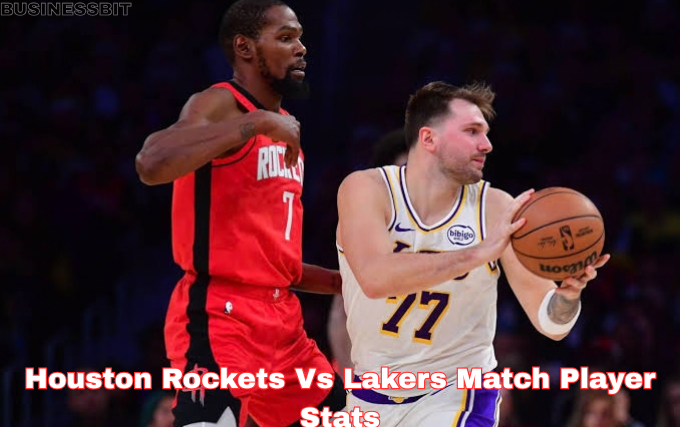

The houston rockets vs lakers match player stats offer a clear look at how the Los Angeles Lakers defeated the Houston Rockets in Game 6 of their 2026 Western Conference first-round playoff series. The Lakers won 98-78 at Toyota Center on May 1, 2026, closing the series with a 4-2 victory. Los Angeles controlled the game after a competitive opening period and used a major first-half scoring run to create separation. LeBron James led the Lakers with 28 points, while Rui Hachimura added 21 points. For Houston, Amen Thompson scored 18 points and Alperen Sengun recorded 17 points and 11 rebounds.
The final score does not tell the entire story. The Lakers finished the game shooting 40.4% from the field and 42.9% from three-point range, while Houston shot 35.0% overall and only 17.9% from beyond the arc. Los Angeles also won the rebounding battle 67-55 and produced 19 assists compared with Houston’s 13. These numbers show why the Lakers were able to control the game even when Houston had stretches of competitive basketball. For anyone researching NBA box scores, player performances, or Houston Rockets vs Lakers match player stats, this matchup provides an excellent example of how shooting efficiency and rebounding can influence a playoff result.
LeBron James Leads the Lakers in Game 6
LeBron James was the leading scorer and primary playmaker for Los Angeles in Game 6. He finished with 28 points, seven rebounds, and eight assists in 37 minutes and seven seconds. James shot 10-for-25 from the field, made two of his five three-point attempts, and converted six of eight free throws. His plus-26 rating was also the best among the Lakers’ main rotation players. These numbers highlight his influence across multiple areas rather than simply his scoring total. James helped create opportunities for teammates while also providing the Lakers with a reliable scoring option whenever Houston attempted to make a run.
James’ impact became especially important during the first half, when Los Angeles turned a close contest into a comfortable lead. The Lakers went on a 27-3 run after Houston had briefly taken control early in the game. James was one of several Lakers who made important shots during that stretch, and his ability to score while creating opportunities for teammates helped maintain offensive pressure. His eight assists were particularly valuable because Houston could not focus exclusively on stopping his scoring. When analyzing Houston Rockets vs Lakers match player stats, James’ performance demonstrates why points, assists, rebounds, and plus-minus should be considered together.
Rui Hachimura Provides Key Three-Point Shooting
Rui Hachimura delivered one of the most efficient offensive performances in the Lakers’ Game 6 victory. He scored 21 points, grabbed six rebounds, and added two assists in 34 minutes and 44 seconds. Hachimura shot 8-for-15 from the field and was particularly effective from three-point range, making five of seven attempts. His 71.4% three-point percentage was an important part of Los Angeles’ offensive success because it forced Houston’s defense to respect him on the perimeter. Hachimura also finished with a plus-20 rating, showing that the Lakers performed extremely well during his minutes.
Hachimura’s shooting helped create better spacing for the Lakers throughout the game. When a forward consistently makes outside shots, defenders have fewer opportunities to collapse toward the paint or double-team a primary ball handler. That gave James additional room to operate while also helping Los Angeles maintain offensive balance. Hachimura’s five three-pointers were part of the Lakers’ 12 total three-point makes. Houston, by comparison, made only five threes throughout the entire game. This difference makes Hachimura one of the most important names to consider when examining Lakers vs Rockets player stats from the decisive playoff matchup.
Austin Reaves Adds Valuable Secondary Scoring
Austin Reaves also played an important role in the Lakers’ offensive production. He scored 15 points on 7-for-14 shooting while recording three rebounds and two assists. Reaves also blocked three shots, adding defensive value to his scoring contribution. His 30 minutes and 41 seconds on the court were particularly notable because he had recently returned from an oblique injury. His ability to provide reliable minutes gave Los Angeles another offensive option alongside James and Hachimura. The Lakers did not need Reaves to become the primary scorer, but his production helped prevent Houston from concentrating all of its defensive attention on James.
Reaves’ performance also illustrates why secondary scoring can be important in playoff basketball. A defense may successfully limit a superstar’s efficiency, but that strategy becomes less effective when other players consistently convert their opportunities. Reaves shot 50% from the field and contributed three blocks, giving him value on both ends of the floor. His contribution was part of a balanced Lakers attack in which several players reached double figures or contributed significantly in other statistical categories. For readers studying Houston Rockets vs Lakers match player stats, Reaves’ numbers provide a useful example of how supporting players can influence a playoff game without leading their team in scoring.
Deandre Ayton Dominates the Rebounding Battle
Deandre Ayton did not have a high scoring total in Game 6, but his rebounding performance was one of the Lakers’ most important statistical advantages. Ayton scored seven points while collecting 16 rebounds, including three offensive boards and 13 defensive rebounds. He also recorded one assist and one block. His 16 rebounds were the highest total by any player in the game and helped Los Angeles finish with 67 total rebounds compared with Houston’s 55. That 12-rebound advantage gave the Lakers additional possessions and helped them control the physical side of the matchup.
Rebounding becomes especially important when a team is struggling with shooting efficiency. Houston made only 28 of its 80 field-goal attempts, meaning every missed shot created an opportunity for Los Angeles to secure possession. Ayton and the Lakers’ other rebounders repeatedly prevented Houston from getting easy second chances. Los Angeles also collected 15 offensive rebounds, compared with eight for Houston. Those extra possessions supported the Lakers’ overall control and helped them produce 98 points despite making only 36 field goals. Ayton’s performance is therefore a strong reminder that player stats should not be judged only by points scored.
Amen Thompson Leads the Rockets in Scoring
Amen Thompson was Houston’s leading scorer in Game 6, finishing with 18 points, eight rebounds, and three assists. He shot efficiently from the field, making eight of his 15 attempts, but Houston needed more consistent production from the rest of its lineup. Thompson’s athletic ability allowed him to contribute as a scorer and rebounder, while his three assists demonstrated his ability to participate in the Rockets’ offensive creation. Despite his individual effort, Houston could not generate enough overall offense to challenge Los Angeles after the Lakers established their first-half advantage.
Thompson’s numbers are particularly interesting when viewed against the team’s overall shooting performance. Houston made 28 of 80 field-goal attempts and just five of 28 three-point attempts. Thompson was able to produce points at a much better rate than the team overall, but basketball is ultimately a five-player game. The Rockets needed multiple players to convert shots efficiently, especially after falling behind early. His 18-point performance was therefore one of the brighter individual statistics for Houston, even though it was not enough to prevent elimination. The matchup also showed the importance of supporting a young core with reliable offensive options in postseason basketball.
Alperen Sengun Records a Double-Double
Alperen Sengun provided Houston with a strong interior performance despite the team’s offensive struggles. He finished with 17 points and 11 rebounds, giving him a double-double in the deciding game. Sengun also contributed two assists and one block. His 11 rebounds were second among all players in the game, behind only Ayton’s 16. Sengun’s ability to score around the basket and compete on the glass remained important for Houston, particularly because the Rockets were unable to generate enough successful three-point attempts. His performance demonstrated his value as one of the team’s central offensive and rebounding options.
However, Sengun’s individual production could not overcome the Lakers’ overall team performance. Houston needed more scoring from its supporting cast and greater success from outside the arc. The Rockets’ 17.9% three-point shooting meant that Los Angeles could devote more defensive attention to interior areas without paying a major price from long range. Sengun still managed to finish with 17 points and 11 rebounds, but his opportunities became more difficult as the game progressed. When evaluating Houston Rockets vs Lakers match player stats, his double-double should be viewed as evidence of individual consistency rather than a reflection of Houston’s overall offensive effectiveness.
Three-Point Shooting Decides the Game
The biggest statistical difference between the Lakers and Rockets was three-point shooting. Los Angeles made 12 of 28 attempts from outside the arc, producing a 42.9% success rate. Houston made only five of 28 attempts, finishing at 17.9%. That difference was enormous in a playoff game because successful three-point shooting can quickly create separation on the scoreboard. Rui Hachimura was particularly effective for Los Angeles, making five of seven attempts. LeBron James and Marcus Smart also contributed multiple three-pointers, giving the Lakers several perimeter threats instead of relying on one shooter.
Houston’s poor three-point performance was even more damaging because the Rockets had recently shown better shooting during the series. According to the NBA’s game recap, Houston had made 26 three-pointers over the previous two games before making only five in Game 6. Reed Sheppard struggled from outside, finishing the game 1-for-10 from three-point range. When a team is unable to convert open perimeter opportunities, the opposing defense can become more aggressive in other areas. That appears to have helped Los Angeles maintain control after its first-half surge. For SEO readers searching Houston Rockets vs Lakers match player stats, three-point efficiency is one of the most important statistics to understand from this game.
Lakers Control the Game Through Rebounding and Ball Movement
The Lakers also had a clear advantage in rebounding and assists. Los Angeles collected 67 total rebounds compared with 55 for Houston, while the Lakers recorded 19 assists against the Rockets’ 13. The Lakers also grabbed 15 offensive rebounds, nearly twice Houston’s eight. These numbers indicate that Los Angeles was able to create additional possessions while moving the ball effectively enough to generate scoring opportunities. James’ eight assists were especially important, but the overall team assist total shows that the Lakers were not dependent on one player to create every basket.
Houston did have a slight advantage in steals, recording six compared with four for Los Angeles, and the Rockets committed 11 turnovers against the Lakers’ 10. Those numbers suggest that turnovers were not the primary reason for the result. Instead, shooting and rebounding created the largest statistical gap. Los Angeles’ 15 offensive rebounds and 12-made-three advantage were particularly difficult for Houston to overcome. The combination allowed the Lakers to generate more scoring opportunities while also limiting Houston’s ability to build momentum. This is an important point for anyone analyzing NBA team statistics: a game can be decided by several connected categories rather than a single headline number.
The Lakers’ 27-3 Run Changes the Match
The decisive moment in Game 6 came during a huge Lakers scoring run. Houston had a five-point lead with roughly five minutes remaining in the first quarter, but Los Angeles responded with a 27-3 surge that changed the entire direction of the game. The Lakers moved ahead 38-19 during that stretch and eventually carried a 49-31 advantage into halftime. Hachimura, Jake LaRavia, and James all made three-pointers during the run, while Houston struggled to generate consistent offense. The sequence demonstrated how quickly a playoff game can change when one team combines defensive pressure with efficient shooting.
Houston’s offensive problems became particularly noticeable early in the second quarter. The Rockets missed 11 consecutive field-goal attempts before Reed Sheppard ended the drought with a field goal. By halftime, the Lakers had already built an 18-point advantage. Houston did manage to win the third quarter 24-22 and the fourth quarter 23-27, but those late improvements could not erase the damage created during the first half. This is why the final Houston Rockets vs Lakers match player stats need to be viewed alongside the game’s scoring runs. A team can perform better late in a contest while still being unable to recover from one major momentum shift.
Houston Rockets vs Lakers Series Result
Game 6 completed a six-game playoff series between the Lakers and Rockets. Los Angeles won the series 4-2 after taking the first three games, while Houston responded with victories in Games 4 and 5 to force a sixth contest. The six game scores were 107-98, 101-94, 112-108 in overtime, 115-96, 99-93, and finally 98-78. The series therefore featured several competitive games before Los Angeles delivered its most decisive performance in the elimination contest.
The series context is important when interpreting individual player statistics. Houston entered the matchup without Kevin Durant for most of the series because of injury issues, while Los Angeles also had Luka Doncic listed as inactive for Game 6. That meant both teams had to adjust their rotations and responsibilities. Houston’s young players, including Thompson and Sengun, carried significant responsibility, while James remained the Lakers’ leading veteran presence. The eventual 4-2 result reflected not only individual performances but also roster availability, defensive execution, shooting consistency, and the ability to win critical possessions throughout a playoff series.
Houston Rockets vs Lakers Player Stats Comparison
| Player | Team | Points | Rebounds | Assists |
|---|---|---|---|---|
| LeBron James | Lakers | 28 | 7 | 8 |
| Rui Hachimura | Lakers | 21 | 6 | 2 |
| Austin Reaves | Lakers | 15 | 3 | 2 |
| Deandre Ayton | Lakers | 7 | 16 | 1 |
| Amen Thompson | Rockets | 18 | 8 | 3 |
| Alperen Sengun | Rockets | 17 | 11 | 2 |
The comparison shows that LeBron James led all players in scoring and assists, while Deandre Ayton led everyone in rebounds. Hachimura was the Lakers’ second-leading scorer and their most efficient high-volume three-point shooter, while Thompson led Houston in scoring. Sengun supplied a double-double with 17 points and 11 rebounds. These individual totals explain several of the most important elements of the final box score, but the team statistics remain equally important. Los Angeles shot more accurately from the field and from three-point range, collected more rebounds, and produced more assists.
Why These Player Stats Matter for NBA Analysis
Player statistics are most useful when they explain how a game was won rather than simply identifying the highest scorer. James’ 28 points mattered because he also created eight assists. Hachimura’s 21 points mattered because five of his eight made field goals came from three-point range. Ayton’s seven points were less important than his 16 rebounds because those rebounds helped Los Angeles control possession. On Houston’s side, Thompson’s 18 points and Sengun’s 17-point double-double showed individual quality, but their contributions were not enough to overcome the team’s poor perimeter shooting. This is why a complete box-score analysis should combine traditional and efficiency statistics.
For fans searching Houston Rockets vs Lakers match player stats, the matchup also demonstrates the importance of context. A player’s scoring total does not always indicate how efficiently that player performed, and a low scoring total does not necessarily mean a player had little impact. Rebounding, assists, defensive plays, shooting percentage, turnovers, and plus-minus can all change the interpretation of a performance. In Game 6, the Lakers had several players contributing in different ways, which made their offense and defense harder to disrupt. Houston had strong individual performances but lacked the collective efficiency needed to extend the series.
Conclusion
The final numbers make the outcome clear. The Lakers defeated the Rockets 98-78, shot 40.4% from the field, made 42.9% of their three-point attempts, and won the rebounding battle 67-55. LeBron James led the scoring with 28 points and added eight assists, Rui Hachimura scored 21 points while making five threes, and Deandre Ayton collected 16 rebounds. Houston received strong performances from Amen Thompson and Alperen Sengun, but the team struggled to score efficiently throughout the game.
The most important lesson from the Houston Rockets vs Lakers match player stats is that playoff success depends on complete team execution. Los Angeles combined efficient perimeter shooting, strong rebounding, balanced playmaking, and defensive pressure to turn an early deficit into a convincing win. Houston’s inability to make three-pointers and its poor offensive stretch during the first half created a deficit that proved too large to overcome. With the 98-78 victory, Los Angeles closed the series 4-2 and advanced to the next round. For basketball fans and NBA analysts, the game stands as a strong example of how individual performances and team-level statistics work together to determine a playoff result.



Pingback: Paul McCartney Age: How Old Is the Beatles Legend?